Maintenance · · 9 min read · by KB Quality Painting
Key takeaways
- Soft washing is low pressure plus the correct cleaning solution. Pressure washing is force. Organic growth responds to the first and only temporarily to the second.
- The damage from over-pressuring is rarely visible on wash day — it shows up as water behind the siding, furred wood or blown mortar joints months later.
- Washing before painting has a different goal than washing for looks: removing the chalking layer that new paint cannot bond through.
- On a home built before 1978, washing painted surfaces is containment-regulated work, not a hose-down.
What a wash actually fixes — and what it doesn't
Most of what makes a Hudson Valley house look tired is sitting on top of the paint rather than under it. Green-black biological film on the shaded elevations, a spring's worth of tree pollen, road grime along the front, cobwebs in the soffits, the powdery residue that comes off an aging coating on your hand. All of that is removable, and removing it can take five years off how a house reads from the street.
What a wash does not do is fix the coating. If the paint is peeling, cracked in a fine web across the boards, or chalking heavily because it has reached the end of its life, washing exposes that more clearly rather than hiding it. That is not a reason to skip it — it is the reason to do it before deciding anything, because a clean house is the only house you can honestly assess. Plenty of exteriors we have been called out to repaint turned out to need washing and some trim and carpentry work, not a repaint at all.
Soft washing and pressure washing are two different jobs
The words get used interchangeably, including by contractors, and they should not be. They describe opposite approaches to the same problem.
Soft washing
Soft washing applies a cleaning solution at low pressure — roughly what a garden hose delivers, generally under a few hundred PSI at the surface — gives it time to work, then rinses. The chemistry kills and releases the organic growth. The water only carries it away.
This matters because the green and black film on the north face of a house is alive. Blast it off with pressure and you have removed what you can see while leaving the roots of it in the surface, which is why a pressure-only clean regrows visibly faster than a soft wash of the same wall. The dwell time is doing the work, and dwell time cannot be rushed with a bigger machine.
Where pressure still belongs
Higher pressure is entirely appropriate on hard flatwork — concrete driveways, walkways, pavers, bluestone and flagstone. Even there the tool matters more than the number: a rotating surface cleaner produces an even result, while someone waving a wand back and forth leaves the striped arcs that will be visible on that driveway for years. Our power washing service uses a surface cleaner on flatwork for exactly that reason, and re-sands paver joints afterward.
What each surface on your house can take
The right answer varies by material, and the honest summary is that almost nothing vertical on a house wants high pressure.
| Surface | Approach | What goes wrong with too much pressure |
|---|---|---|
| Vinyl siding | Soft wash, spraying downward | Water forced up behind the panels through the lap joints, where it sits. Upward spray is the single most common mistake |
| Aluminum siding | Soft wash | Oxidized surface streaks unevenly, and dents are easy on thin panels |
| Wood and cedar | Soft wash with a wood-appropriate cleaner | Grain raises and the surface furs, adding a full sanding stage the job did not need |
| Fiber cement | Soft wash | Water into butt joints and behind the boards; caulk lines opened |
| Stucco | Soft wash, low and steady | Surface eroded and water driven into hairline cracks and the wall behind them |
| Brick and stone | Soft wash | Mortar joints blown out — old lime mortar is much softer than it looks |
| Concrete, pavers, stone flatwork | Higher pressure with a surface cleaner | Zebra striping from wand work; joint sand washed out |
| Gutter faces | Dedicated cleaner, then rinse | Nothing — pressure alone will not touch the black streaking |
That last row is worth a sentence of its own, because it is the question we get asked most. The dark vertical stripes running down gutter faces are not dirt. They are oxidized aluminum combined with asphalt runoff from the roof above, bonded to the surface. No amount of pressure removes them, and turning the machine up only dents the gutter. They come off with a cleaner formulated for the job.
The four ways a wash damages a house
None of these show up on wash day. That is what makes them worth knowing about, because the house looks great when the crew leaves either way.
Water behind the siding
Siding is designed to shed water running down it, not water arriving from underneath at pressure. Spray upward into a lap joint or under a window lip and water goes into the wall cavity. Sometimes it dries. Sometimes it finds sheathing and stays. This is also why washing and painting cannot happen the same day — more on that below.
Furred and raised wood
Pressure lifts the soft spring growth out of a wood surface and leaves it fuzzy. Once that happens the only remedy is sanding the whole elevation flat again, which is real time and real money added to a repaint that was quoted before anyone furred anything.
Eroded masonry and open joints
Old mortar, soft brick and stucco all give up material under a concentrated stream. On the older housing stock in Newburgh and the village centers of Warwick and Montgomery, that is a genuine risk rather than a theoretical one.
Everything else in range
Window seals, screens, light fixtures, exterior outlets, dryer and attic vents, AC condensers, and the plantings underneath all of it. A professional wash spends real time on preparation — covering beds, closing windows, protecting fixtures and electrical, planning where the runoff goes — and finishes by rinsing the beds and walkways down. That preparation is most of the difference between a wash and a hosing.
If your home was built before 1978, this is regulated work
Washing a painted surface on a pre-1978 home is not a loophole around lead-safe rules. The EPA's Renovation, Repair and Painting rule does not prohibit pressure washing, but it does hold it to the same containment requirements as any other work that disturbs paint: the work area has to be isolated so that no dust or debris — including in the waste water — leaves it, and the containment has to stay intact while the work is going on. The EPA specifically warns against uncontained hydroblasting, because it spreads chips and debris well past any containment.
In practice this is another argument for low pressure and chemistry on an older home: it is far easier to control where the water and the residue go. A good deal of the housing in Orange County predates 1978, so this comes up constantly here. Our guide to lead paint safety in pre-1978 homes covers the rest of what changes, and the EPA publishes the program requirements in full at epa.gov.
Washing before a repaint is a different job
A cosmetic wash is finished when the house looks clean. A wash that is stage one of an exterior repaint is finished when the surface will actually bond, and that is a higher standard.
The chalk test
Run your hand firmly down a sunny elevation. If it comes away with a powdery film, that is chalking: the binder in the old coating breaking down under UV and releasing pigment. Fresh paint cannot bond through it, and every paint manufacturer says the same thing — any surface with a chalky feel has to be cleaned before it is coated. Skip that step and the new coating is holding onto powder rather than onto the house.
Then it has to dry
The washing-and-painting mistake that costs a whole elevation: washing in the morning and coating in the afternoon. Water driven up behind siding has to work its way back out before anything seals it in, and the substrate itself has to return to a normal moisture level. Depending on the material, the weather and how shaded the elevation is, that is one to three days — never the same day. Trapped moisture blisters the film from underneath, and the failure shows up on the elevation that was hardest to dry.
This is one of the more useful questions to put to any contractor bidding your exterior: when do you wash, and when do you start coating? A schedule with no gap between them is telling you something. There are more of those in our 12 questions to ask before hiring a painting contractor.
Wash, repaint, or both?
| What you are seeing | What it usually means |
|---|---|
| Green-black film on north and shaded walls; the paint underneath is sound | A wash. The coating has years left |
| Pollen, road grime, cobwebs, general dullness | A wash, ideally on a maintenance rhythm |
| Light chalking, color looking flat, no cracking or peeling | A wash now, and start planning the repaint |
| Heavy chalking plus hairline cracking | The coating is at end of life. Wash as stage one of a repaint |
| Peeling, bare wood, failed caulk at joints | Repaint, with carpentry and caulking addressed first |
| Soft or spongy trim, sills or fascia | Rot. Neither washing nor painting is the answer until it is repaired |
If you are somewhere in the middle of that table, how long exterior paint lasts in the Hudson Valley goes through the warning signs in more detail, and the exterior painting cost guide covers what a full repaint involves here.
When to wash in Orange County
Washing has a longer season than painting does, because nothing has to cure. Spring is the natural time — after the pollen has finished, before the house is being looked at all summer. Early autumn is the other good window, and it is the right one if a repaint is following, since the coating still has settled weather to cure in. Our guide to the best time of year to paint here covers the temperature limits that decide the painting half of that schedule.
How often depends far more on your lot than on your siding. A house sitting in full sun with air moving around it can go several years and look fine. A house under mature trees on a shaded slope — which describes a great many properties around Greenwood Lake, Cornwall and the wooded roads of New Windsor — grows a visible film on its north face every single year. Those houses want an annual or every-other-year rhythm, and they are the ones where letting it go for a decade means the growth has worked into the coating rather than sitting on it.
Decks and fences are on their own schedule and their own method — a wood-appropriate cleaner, low pressure, then a brightener before any coating goes on. That process is covered in the deck staining guide and on the deck staining and sealing page.
What a professional wash day actually looks like
It is less dramatic than people expect, and the quiet parts are the parts that matter.
- Walk the house first. Note the failed caulk, the open joints, the soft trim, the vents and fixtures, and any window that will not stay closed. Anything found here is better known before the water starts.
- Protect. Cover plantings, close and check windows, protect fixtures, outlets and the condenser, and decide where runoff goes.
- Apply and dwell. Solution on, from the bottom up, and left to work. Shaded elevations get more dwell time, not more pressure.
- Rinse. Top down, spray angled downward, joints and undersides of laps respected.
- Rinse the beds and the walkways. Then look at the house wet and again once it dries, because the two do not always agree.
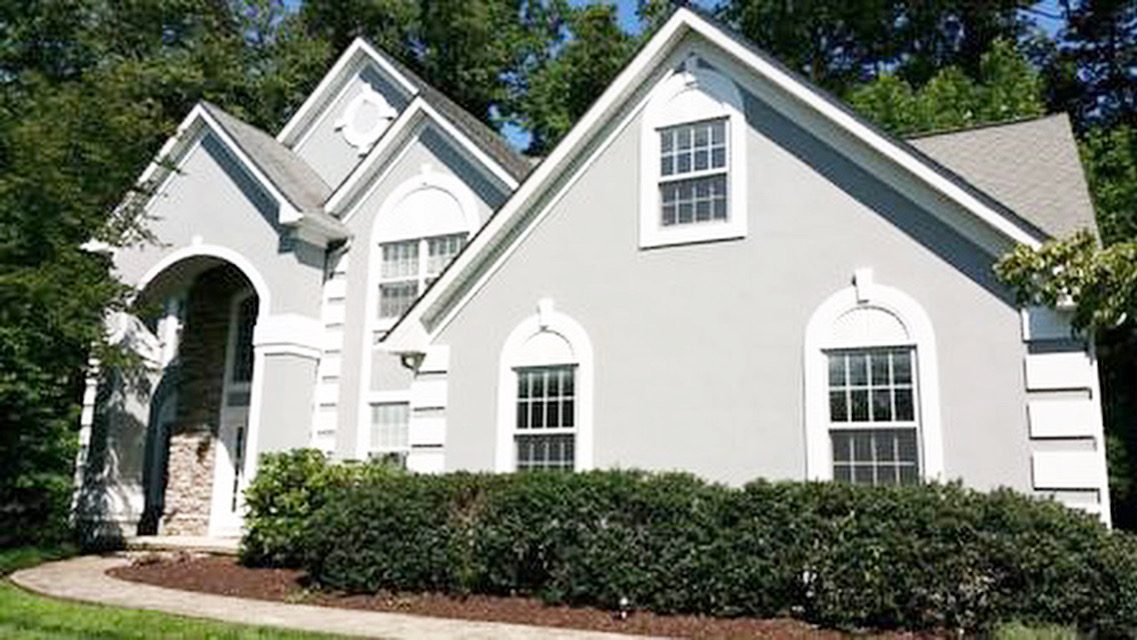
A two-story home is usually most of a day. You can see the result of that process as the first stage of a repaint on our stucco exterior in New Windsor and the Cape Cod exterior repaint in Cornwall — both of which began with a full low-pressure wash before a drop of paint was opened.
Doing it yourself
A rented machine on a fence, a shed, a patio or a driveway is a reasonable Saturday. The risk is low and the worst outcome is uneven concrete.
A two-story house is a different proposition. The three things that go wrong are working off a ladder with a wand that pushes back, spraying upward into siding because that is the only angle available from below, and using pressure to compensate for not having the right solution. All three are how the damage in this article actually happens — and none of it is visible until later. If the house is older than 1978, add the containment obligations above, and the calculation stops being close.
If you want a straight answer about which of those your house needs, ask us for an estimate — we will tell you if it is a wash rather than a repaint, because a customer who gets three more good years out of their coating calls us when they finally need it. There are more common questions on our FAQ page, and you can see the towns we cover on the service areas page.