Maintenance · · 10 min read · by KB Quality Painting
Key takeaways
- Peeling is almost always water or adhesion, and where it happens on the house tells you which. A patch outside the bathroom, a band under the eaves and sheets lifting off a whole wall are three different problems.
- Pick at a blister. If it goes down to bare wood, moisture is pushing the paint off from behind. If there is old paint underneath, the new coat never bonded to the old one.
- Repainting over an unsolved moisture source buys you one or two seasons. Fix the water first — gutter, vent, flashing, caulk or rot — then paint.
- On a house built before 1978, scraping peeling paint is lead-regulated work, and the peeling areas are exactly the ones that get disturbed.
Peeling is a symptom, not the problem
Most homeowners notice peeling paint the same way: a strip curling off a window sill, a scatter of flakes on the mulch under the eaves, or a patch of bare grey wood on the side of the house nobody looks at much. The instinct is to scrape it and put a fresh coat on. Sometimes that is exactly right. More often, it is how people end up repainting the same wall three years later and wondering what went wrong.
Paint does not usually peel because it was bad paint. It peels because something got between it and the surface — water behind the film, chalk or dirt under it, or an old coating it could never grip. In the Hudson Valley the first of those does most of the damage, because our winters cycle across freezing again and again, and water trapped behind a paint film does mechanical work every time it freezes. We covered that in more detail in how long exterior paint lasts here, where peeling gets a single paragraph as a warning sign. This is the longer version: how to read it.
The useful thing about peeling is that it is rarely random. Where it happens, and what it looks like up close, will usually tell you the cause before anyone climbs a ladder.
First, look at what is under the flake
Before you worry about where the peeling is, find a loose flake or an unbroken blister and look underneath. There are really only two answers, and they point in different directions.
| What you find | What it usually means | Where the fix is |
|---|---|---|
| Bare wood under the flake, and several coats came off together | Moisture is pushing the paint off from behind | Find and stop the water, then repaint |
| Old paint under the flake — only the newest coat lifted | The new coat never bonded to the old one: chalk, dirt, gloss, or latex over old oil | Preparation, and sometimes a bonding primer |
| Small bubbles in the top coat only, soon after painting, on a sunny side | Heat blistering — the paint went onto a surface that was too hot and skinned over | Scrape, sand and recoat in the right conditions |
| A fine network of cracks and curling edges over the whole wall | An old, thick film that has lost its flexibility | Often more removal than a normal repaint |
The distinction between the first two rows matters more than anything else in this article. Sherwin-Williams puts it simply in its own guidance: if blisters go down to the substrate, the cause is likely moisture escaping from the surface; if they only go down to a previous coat, it is an adhesion problem between layers. One is a house problem. The other is a paint-job problem. They are quoted, and fixed, completely differently.
Reading the pattern on the house
Once you know whether you are dealing with water or adhesion, walk the outside of the house and notice where the damage sits. The location is usually the diagnosis.
A patch on the wall outside the bathroom or kitchen
This is the classic one, and it confuses people because the siding looks fine everywhere else. Showers, cooking and a dryer vented into a wall cavity all put warm, wet air inside the house, and that moisture tries to move outward through the wall. When the sun warms the siding it draws that moisture toward the paint film and pushes it off, usually right down to bare wood. It is especially common in older houses, which describes plenty of the housing in Newburgh, Goshen and the other village centers around the county.
The fix is inside, not outside: a bathroom exhaust fan that actually vents to the exterior and gets used, a kitchen hood that goes somewhere, a dryer duct that is connected end to end. Repaint that patch without dealing with the moisture and it will peel again in the same shape.
A band along the top of the wall, under the eaves
Peeling or bulging paint high on a wall, just below the roof line, points to water coming from above — an overflowing or leaking gutter, a roof leak, or winter ice at the eaves backing meltwater up under the roofing and into the top of the wall. Look at the fascia and soffit while you are up there looking: if they are stained or soft, the water has been getting in for a while.
A gutter that overflows onto the same stretch of siding every storm will destroy the paint below it no matter how well it was applied. Clearing and re-pitching the gutter costs a fraction of the repaint it protects. Where the roof meets a sidewall — a dormer, a garage roof tying into a two-story wall — missing or failed flashing does the same thing, and that is a roofing repair before it is a painting one.
Window sills, the bottom of trim and the lowest boards
Horizontal surfaces and the cut ends of boards take on water that vertical faces shed. Window sills hold rain, the bottom edges of clapboards and corner boards wick it up through the end grain, and the lowest courses of siding get splashback from the ground, sprinklers and snow piled against the house all winter. Paint on those surfaces fails first on every house we look at.
If the peeling is only on window trim, check the caulk and the joint between the window frame and the casing — an open joint lets water behind the trim, and the paint on the face is simply where you see it. Press a screwdriver into any sill or bottom board where the paint has let go. If it sinks in, that is rot, and it needs carpentry repair before it needs paint. Coating over soft wood is the most expensive shortcut in exterior work, because you pay for the paint now and the repair later anyway.
Sheets of paint lifting off a whole wall
When large areas of newer paint come away in sheets with older paint still sound underneath, it is almost never water. It is a coat that was put onto a surface it could not grip. The usual culprits are chalk — the powdery residue on aging paint that has to be washed off before anything will bond to it — and a latex topcoat applied over old oil-based paint without the right preparation. Old oil paint keeps hardening and gets more brittle with age, and a flexible latex film bonded to it can pull it apart as it moves. That is why sanding the gloss off and using a primer designed to bond to old oil finishes is part of repainting an older house properly.
If the whole wall is failing to bare wood rather than coat-on-coat, the siding may simply have no way to dry. That happens where the wall has been sealed tight on both sides, or where shrubs and soil sit against the boards year-round.
Small bubbles on the sunny side, soon after a repaint
Blisters that appear in the top coat within days or weeks of a paint job, mainly on south and west elevations, are usually heat blisters. The paint went onto a surface that was too hot, skinned over before the film underneath could release its water, and bubbled. Good crews follow the shade around the house on hot days for exactly this reason — more on that in the best time of year to paint in the Hudson Valley. Cut one open: heat blisters have paint underneath; moisture blisters have bare wood.
A quick diagnostic you can do yourself
| Where it peels | Most likely cause | Fix before painting |
|---|---|---|
| Outside a bathroom, kitchen or laundry | Interior moisture moving out through the wall | Exhaust fans and vents that actually vent outside |
| Top of the wall, below the eaves | Gutter overflow, roof leak, winter ice at the eaves | Gutter or roof repair; check fascia and soffit |
| Where a roof meets a sidewall | Missing or failed flashing | Flashing repair by a roofer |
| Window trim only | Open joints around the frame, failed caulk | Seal the joints; replace soft trim |
| Sills, board ends, bottom courses | Horizontal surfaces and end grain holding water | Rot repair, prime all cut ends, clear soil and shrubs |
| Whole wall, new paint off old paint | Chalk, dirt or gloss not prepped; latex over old oil | Proper wash, sanding and a bonding primer |
| Top-coat bubbles on the sunny side | Painted on a hot surface | Scrape and recoat in the shade |
Most houses show more than one of these. That is normal, and it is also why the honest answer to "can you just paint over it?" is usually "some of it."
If your home was built before 1978
Peeling paint on an older house is a lead question before it is a painting question. Any home built before 1978 may have lead-based paint in its lower layers, and peeling areas are exactly the areas that get scraped. For contractors, disturbing that paint falls under the EPA's Renovation, Repair and Painting rule: certified firms, containment on the ground, and no uncontained dry scraping on exteriors. If you are thinking of scraping it yourself, read our guide to lead paint safety in pre-1978 homes first — particularly if children live in or visit the house.
What a proper fix looks like
Once the cause is dealt with, repairing peeled areas is not complicated, but every step matters, and skipping any one of them brings the peeling back:
- Stop the water. Gutter, vent, flashing, open joint or wet soil against the wall — whichever it is, first.
- Wash. A low-pressure wash takes off the chalk and grime new paint cannot bond through, without driving water into the siding. See soft washing vs. pressure washing for what each surface can take.
- Let it dry. One to three days, depending on the siding and the weather. Painting over trapped moisture is how blistering starts.
- Scrape to a sound edge and feather it. Every loose flake comes off, and the edge of the remaining paint gets sanded smooth so it does not read as a ridge — or become the next place the film lets go.
- Repair the wood. Soft sills, split trim and rotted board ends get repaired or replaced, not painted.
- Prime all bare wood, with a primer suited to the surface — including a bonding primer where the old coating is oil and the new one will be latex.
- Caulk open joints with a flexible exterior sealant, then two finish coats in the right conditions.
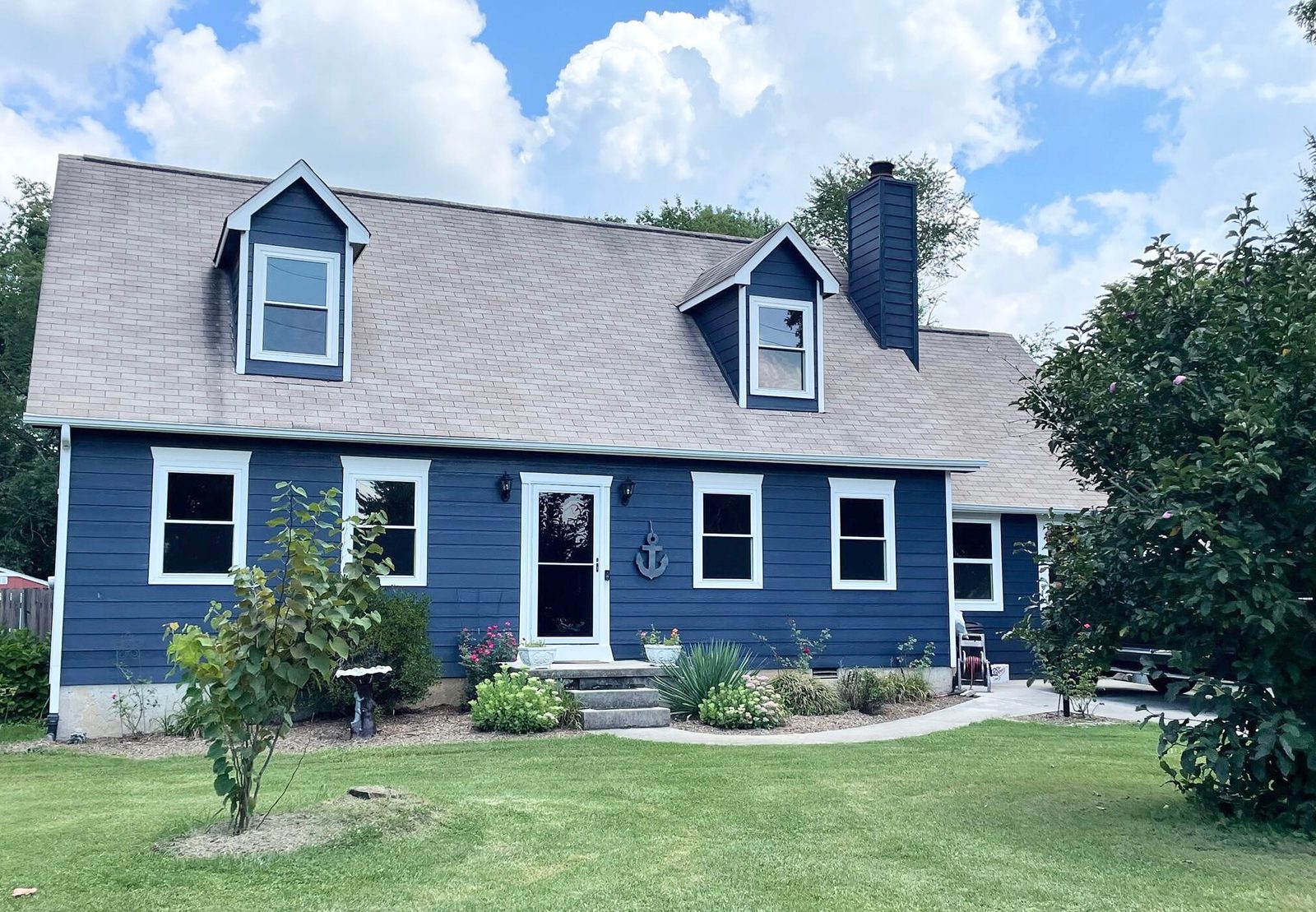
That sequence is the same one our exterior painting process follows on every house, and you can see it on the Cape Cod exterior we repainted, where loose paint was scraped and feathered and the trim and sill rot repaired before anything was coated. Stucco is a different case: it needs a breathable coating, or trapped moisture pushes the film off in sheets — the stucco exterior and trim project shows how that is handled.
Spot repair or full repaint?
If the peeling is confined to a few areas with a clear cause — the wall outside the bathroom, the sills, one run under a bad gutter — and the rest of the paint is sound, a targeted repair after fixing the cause is a perfectly reasonable answer. Expect the repaired areas to look fresher than the rest, and expect matched paint over weathered paint not to blend perfectly.
If the peeling is spread across several elevations, if the paint chalks heavily when you rub it, or if the film is cracked all over, the coating is at the end of its life and spot repairs will chase it around the house. That is a repaint, and the prep will be a bigger share of the job than on a house that was caught earlier. Our exterior painting cost guide explains how the condition of the existing paint changes the price.
Is there still time this year?
September is one of the best exterior painting windows of the year in Orange County, and early October is usually still workable. By late October the overnight lows start to rule out coating, because paint applied that afternoon cannot cure properly once the surface drops below the product's minimum.
If you spot peeling late in the season, the winter is not wasted. Use it to fix the cause — the gutter, the fan, the flashing — so that when the season reopens in spring, the paint goes onto a wall that has stopped getting wet. That is a better outcome than a rushed coat in November that fails by April.
Getting it looked at
Peeling paint is one of the easiest things to diagnose in person and one of the easiest to misquote from a photo. Standing next to the wall, it takes a few minutes to see whether the paint is coming off bare wood or old paint, where the water is coming from, and which boards are soft underneath.
We do exterior painting, washing and exterior prep and trim repair across seventeen Orange County towns. If your paint is letting go, book a free estimate and we will tell you what is causing it and whether it needs a repair, a repaint, or a fix to the house first. More common questions are answered on our FAQ page.